
Skip to content
Every Mechanism

Home How a Turbocharger Works

A turbocharger, opened up

How a turbocharger works

Hot exhaust spins a little wheel, and that wheel spins a second one that packs extra air into the engine. More air lets the engine burn more fuel, so a small engine makes the power of a big one.
Take it apart
150,000rpm
the shaft at full boost
1.0bar
of boost above the outside air
×2
almost twice the air in each cylinder
900°C
on the turbine side
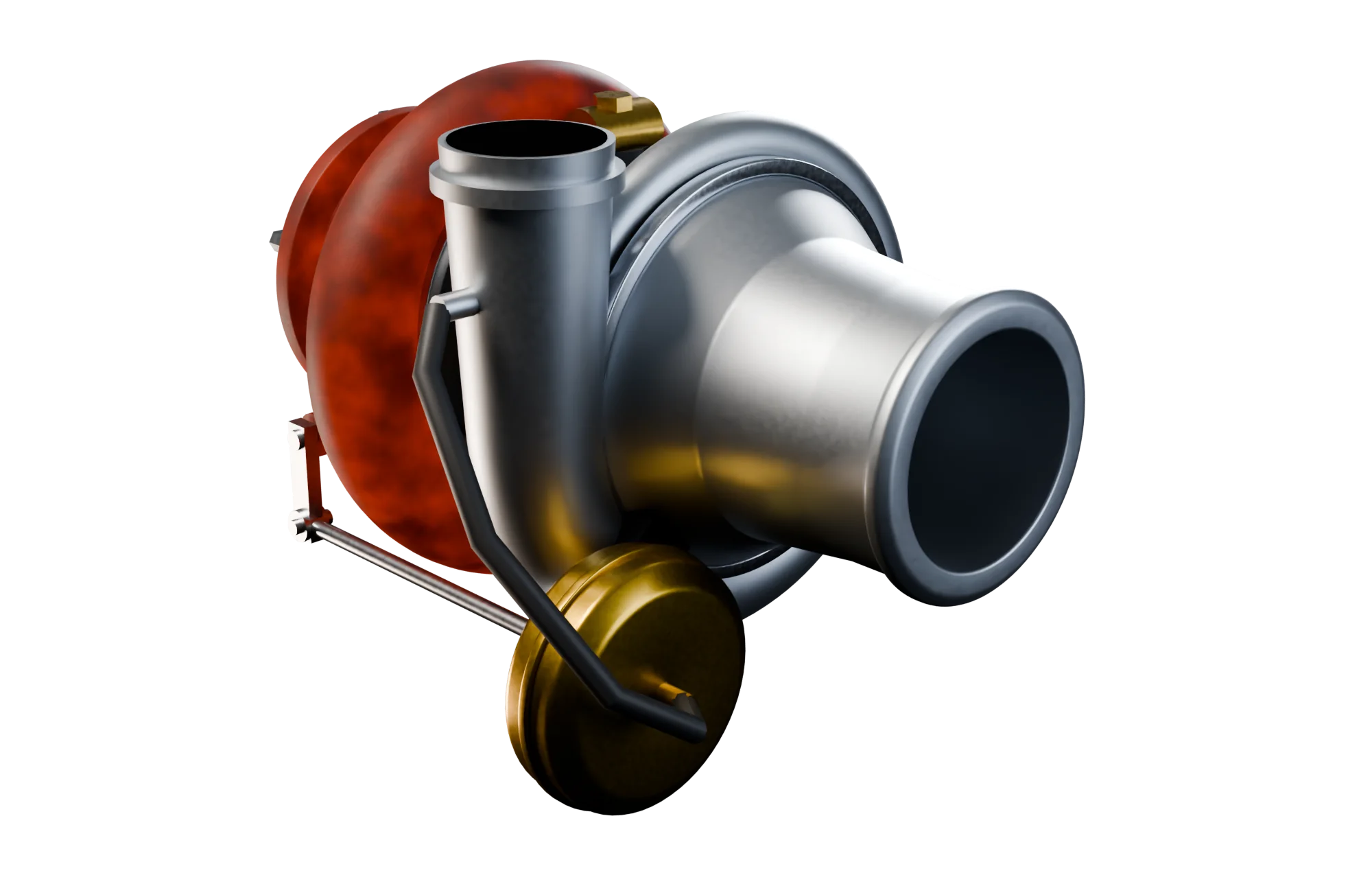
A turbocharger: a cast-iron turbine housing glowing red-hot on one side, a polished aluminium compressor housing on the other, and the gold wastegate actuator below.

Video

How a Turbocharger Works - Turning Exhaust Heat Into Power

Watch on YouTube

3D model · 360° · zoom

Spin it up yourself

The turbo is already cut in half and the pipes are see-through. Start the engine and open the throttle: orange dots are hot exhaust, blue dots are fresh air. Drag to turn it, scroll or pinch to zoom.

Try itStart the engine, then open the throttle. Orange dots are exhaust, blue dots are fresh air.
Loading the 3D model…
Look at

Scroll to take it apart

Two wheels, one shaft

Keep scrolling: the two housings slide off the ends, then the whole turbo is sawn in half.

Loading frames…
  1. Step 1Slide off the cold sideThe aluminium compressor housing comes off, with the actuator on its bracket.
  2. Step 2Slide off the hot sideThe cast-iron turbine housing comes off the other end. The rotor stays in the middle.
  3. Step 3Saw it in halfNow you can see both wheels, the shaft, the bearings and the oil and coolant passages.
Meet the parts

Eleven parts, one rotor

Tap any part of the cutaway or pick a name below. The cold side squeezes the air, the hot side takes energy from the exhaust, and the middle keeps the shaft spinning on oil.

The turbocharger taken apart along its shaft and cut in half: the compressor housing at the top, the rotor and centre housing in the middle, the turbine housing at the bottom.

Hover or tap the cutaway. Yellow rings mark every part.

Parts diagram

Follow the air, then the exhaust

Seen from above the engine bay. Numbers 1 to 9 follow the fresh air from the filter into the engine. Numbers 10 to 14 follow the exhaust out through the turbine. 15 to 17 keep the turbo alive.

The engine, the turbocharger and their pipes seen from above, with seventeen numbered parts along the air path, the exhaust path and the oil and coolant lines.
    How it works, step by step

    From wasted heat to power

    The whole story in thirteen steps, one idea at a time. Pick a step, or press Show me in 3D to see it happen on the model.

    The engine bay with the turbocharger: orange exhaust flows into the turbine, blue air leaves the compressor.

    Free power from the exhaust

      Exhaust in, boost out

      Feed the turbine, watch the boost

      Rev the engine and open the throttle. More exhaust spins the turbine faster, and the compressor’s pressure rises with the square of its speed, until the wastegate opens and holds it at the limit.

      0turbo speed, rpm
      0.00boost, bar
      ×1.0air in each cylinder
      0power, kW

      Turbo lag

      Floor it at low revs

      Stamp on the throttle at 1,800 rpm. The engine answers at once, but the boost has to wait: there is little exhaust yet, and the rotor needs a moment to spin up. Try the fixes engineers use and compare the curves.

      Boost after flooring it

      Pick the turbos to compare, then floor it.
      1,800engine, rpm
      20,000turbo, rpm
      −0.31boost, bar
      –time to 0.6 bar, s

      The intercooler

      Hot air is thin air

      Squeezing air heats it. Turn up the boost and see how hot the air gets, how much heat the intercooler takes out, and how much more air ends up in each cylinder.

      115after the compressor, °C
      45into the engine, °C
      ×1.9air in each cylinder
      Lowrisk of knock

      The blow-off valve

      Lift off: psssh!

      Hold the throttle to build boost, then let go. The throttle snaps shut, but the turbo is still spinning and pumping. With a blow-off valve the trapped air escapes. Without one it pushes back through the compressor wheel: that is compressor surge.

      0.00pressure in the pipe, bar
      20,000turbo speed, rpm
      Shutblow-off valve
      Steadycompressor

      More to know

      Kinds, history and care

      Kinds of turbo, and a cousin

      Single turboOne turbo for the whole engine, like the one on this page. Simple, light and the most common.
      Twin-scrollA wall splits the turbine spiral in two, so the exhaust pulses from cylinders 1 and 4 don’t get in the way of those from 2 and 3. It spools up sooner.
      Twin-turboTwo turbos: often one for each bank of a V engine, or a small one for low revs and a big one that joins in later (sequential).
      Variable geometryMovable vanes round the turbine wheel change how fast the gas hits it: quick response at low revs, plenty of flow at high revs. Common on diesels.
      Electric assistA motor on the shaft spins the turbo up before the exhaust can. From 2014 to 2025, Formula 1 engines had one that also made electricity.
      SuperchargerNot a turbo: a compressor driven by a belt from the crankshaft. There is no lag, but driving it costs some of the engine’s power.

      From ships and bombers to every car park

      1. Swiss engineer Alfred Büchi patents the idea of using an engine’s exhaust to drive a compressor that feeds it more air.
      2. Sanford Moss of General Electric tests a turbo-supercharged aircraft engine on Pikes Peak, more than 4,000 m up, where the air is thin.
      3. Turbocharged diesel engines go to sea in big passenger ships.
      4. Turbo-superchargers let aircraft such as the B-17 bomber and the P-38 fighter keep their power high in the sky.
      5. The Oldsmobile Jetfire and the Chevrolet Corvair Monza Spyder are the first turbocharged production cars.
      6. The BMW 2002 Turbo, the Porsche 911 Turbo and the Saab 99 Turbo bring turbos to sports cars and family cars.
      7. Renault brings a turbo engine to Formula 1. By the mid-1980s, 1.5-litre turbo engines make well over 1,000 horsepower in qualifying.
      8. Formula 1 goes turbo again, now with an electric motor-generator on the turbo shaft.
      9. Turbos sit in a huge share of new petrol cars, in almost every diesel car and truck, and in ships, trains and generators.

      Keeping one healthy

      • Change the oil on time and use the grade the maker asks for. The bearings live on it.
      • After a hard run, drive gently for the last minute or two, so the oil and coolant can carry the heat away before you switch off.
      • Let the engine warm up before using full boost. Cold oil flows slowly to the bearings.
      • Keep the air filter clean and well sealed. Grit that gets past it chips the compressor blades.
      • A hiss under boost and a loss of power often mean a leaking hose or coupler: a boost leak.
      • A siren-like whine, shaft play or blue smoke from the exhaust are signs of worn bearings or seals. Have it checked before it fails.

      Things worth knowing

      Faster than soundAt 150,000 rpm the tips of the 60 mm compressor wheel move at about 470 metres a second, faster than the speed of sound in air.
      2,500 turns a secondThe shaft spins about 2,500 times every second, and it never touches its bearings: it floats on a film of oil.
      Red hotExhaust from a petrol engine at full power can reach 900 to 1,000 °C. That is why the turbine side is made of cast iron and nickel alloys.
      Mountains don’t matterA normal engine loses power as the air thins with altitude. A turbo just spins a little faster and makes up most of it.
      Not every turbo goes pssshMany cars send the vented air quietly back into the intake, ahead of the compressor. The famous whoosh comes from valves that vent to the open air.
      Small engine, big powerA turbocharged 1.0-litre three-cylinder can match an older 1.6-litre engine, and use less fuel when it is driven gently.
      Quick check

      Four questions