
Skip to content
Every Mechanism

Home How a Torque Converter Works

The fluid clutch of an automatic car

How a torque converter works

Stop at a red light in an automatic car and the engine keeps running, still in gear, without stalling. The trick is a sealed steel can full of oil between the engine and the gearbox.
Take it apart
×2
torque when you pull away
3
wheels of blades in the oil
0
solid links at a red light
1948
first in a mass-made car
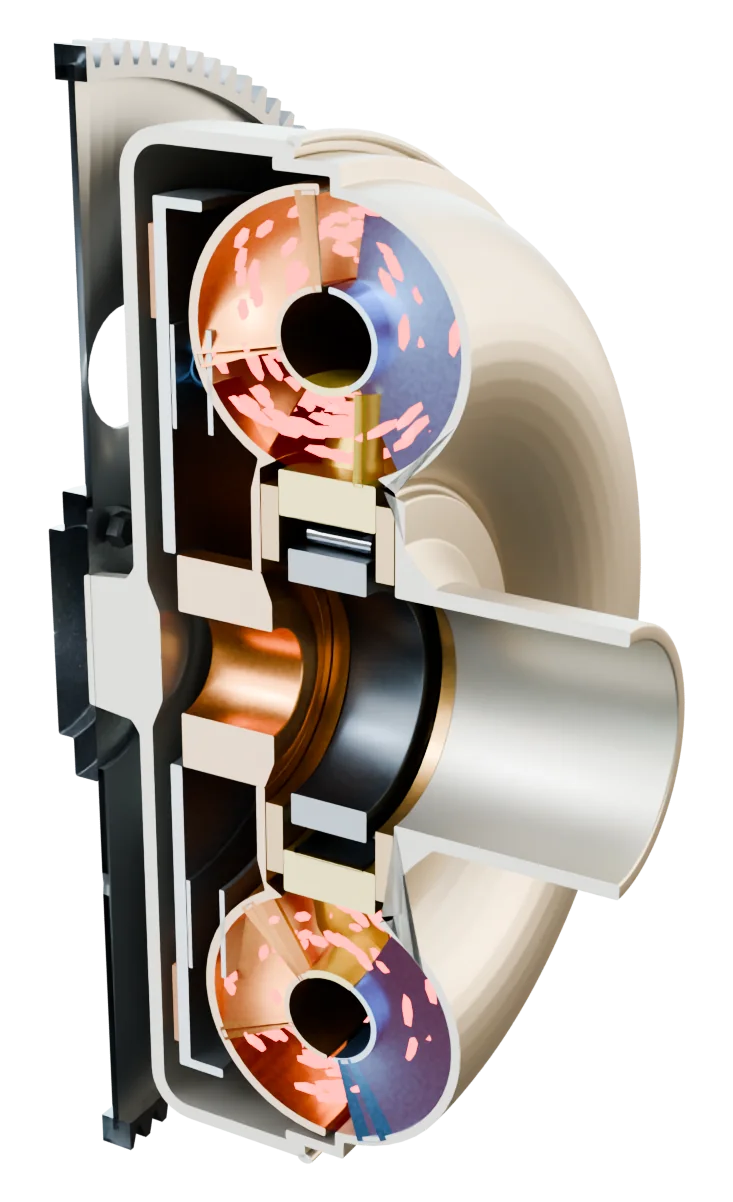
A torque converter cut in half: the blue impeller and the copper turbine face each other inside the steel housing, with the gold stator between them and red oil swirling through the blades.

Video

How a Torque Converter Works - Why an Automatic Car Doesn't Stall

Watch on YouTube

3D model · 360° · zoom

Spin it up yourself

It is already cut in half. Start the engine, let go of the brake and press the accelerator. The red dots are the oil. Drag to turn it, scroll or pinch to zoom.

Try itStart the engine, then let go of the brake. Blue is the impeller, copper the turbine, gold the stator, and the red dots are the oil.
Loading the 3D model…

Scroll to take it apart

One sealed can, eleven parts

Keep scrolling: the parts slide apart along the shaft, then a scan saws them all in half.

Loading frames…
  1. Step 1A welded steel canThe cover and the impeller shell are welded into one can, full of oil. It bolts to the engine.
  2. Step 2Slide it apartFlexplate, cover, lock-up clutch, damper, turbine, stator and impeller, in order along the shaft.
  3. Step 3Saw it in halfNow you can see the curved blades inside, and the one-way clutch in the stator’s hub.
Meet the parts

Eleven parts, three speeds

Tap any part of the cutaway or pick a name below. Some parts always turn with the engine, some turn with the wheels, and the ones in the middle either stand still or freewheel.

The torque converter taken apart along its shaft and cut in half: flexplate and cover at the top, then the lock-up clutch, damper, turbine, stator and impeller, with the shafts down the middle.

Hover or tap the cutaway. Orange rings mark every part.

Parts diagram

Follow the power

The top half of the converter, cut through the middle. The numbers follow the power from the engine’s crankshaft, through the oil, to the gearbox’s input shaft. The arrows show which way the oil goes round.

Cross-section of the top half of the torque converter: the flexplate and cover on the left, the impeller and turbine forming a doughnut full of red oil, the stator between them, and the lock-up clutch beside the cover.
    How it works, step by step

    From the red light to the highway

    Twelve steps, from waiting at a red light to cruising on the highway. Each one has a button that sets up the 3D model to show it.

      Inside the see-through car: the engine on the left, the torque converter in the middle and the gearbox on the right.

      Between the engine and the gearbox

        Demo · the two fans

        A breeze that turns a fan

        Switch on fan A and its breeze pushes fan B round. Fan B always turns a little slower: that difference is the slip. A torque converter does the same with oil, about 700 times heavier than air, so it can carry a car’s power.

        0fan A, rpm
        0fan B, rpm
        –slip
        –power passed on

        Demo · torque multiplication

        The stator’s trick

        Oil leaving the turbine heads backwards, against the way the impeller turns. The stator’s curved blades turn it round, so it helps the impeller instead of fighting it. Slide the turbine speed up and watch the oil, the stator and the torque.

        ×2.00torque to the gearbox
        Heldstator
        Frontoil hits the blades’
        0%efficiency

        Demo · the whole story

        Drive it from the red light

        You’re stopped at a red light, in drive, with the engine running. Keep the brake on and the car waits. Let it go and press the accelerator to pull away. At cruising speed, lock the converter up.

        0engine, rpm
        0turbine, rpm
        –slip
        ×2.0torque
        0km/h
        82 °Cfluid

        Keys: B brake, ↑ / ↓ accelerator, L lock-up.

        More to know

        Kinds, history and care

        Six kinds of fluid drive

        Fluid couplingJust an impeller and a turbine, with no stator. It can slip but never multiply torque. Early automatics used one, and so do many conveyors and heavy machines.
        Three-element converterImpeller, turbine and stator, like the one on this page. The stator multiplies torque at low speed and freewheels once the car is moving.
        Lock-up converterAdds a clutch that locks the turbine to the housing at cruising speed, so nothing slips. Nearly every car automatic today has one.
        High-stall converterBuilt to slip more, so a racing engine can rev up into its power before the car moves. Drag cars can launch at 4,000 rpm or more.
        Heavy-duty convertersBuses, forklifts, diggers and some trains use bigger converters, some with extra stages, that multiply torque three times or more.
        Variable-pitch statorIn the 1950s and 60s some cars had stator blades that could change their angle: steeper for a strong pull away, flatter for a smooth cruise.

        From ships to every automatic

        1. Hermann Föttinger patents the hydrodynamic transmission in Germany, to link fast steam turbines to slow ship propellers.
        2. Daimler fits Harold Sinclair’s fluid flywheel, a fluid coupling, to its buses and cars.
        3. Oldsmobile’s Hydra-Matic, the first mass-produced fully automatic gearbox, uses a fluid coupling.
        4. Buick’s Dynaflow brings the torque converter to the mass-produced car.
        5. Packard’s Ultramatic adds a lock-up clutch for direct drive at speed.
        6. Chevrolet’s Powerglide puts a converter automatic in an everyday, low-priced car.
        7. After the oil crises, lock-up clutches come back to save fuel.
        8. Eight-, nine- and ten-speed automatics lock up from the low gears, so the converter mostly helps the car pull away.

        Keeping one healthy

        • Check the gearbox fluid the way the maker says: many newer gearboxes have no dipstick. Most fluid starts out red. Brown fluid that smells burnt has been too hot.
        • Don’t hold the car on the brakes with the accelerator floored for more than a few seconds. At stall, all the engine’s power heats the oil.
        • Use the fluid the maker names. The lock-up clutch and the gearbox clutches are made for its friction.
        • A shudder at a steady speed, like driving over rumble strips, is often the lock-up clutch slipping and gripping.
        • If the engine revs climb but the car doesn’t speed up, something is slipping: low fluid, a worn clutch or the converter itself.
        • Keep the cooler clean. The heat the converter makes leaves through the cooler lines and the radiator.
        • Don’t tow most automatics far with their drive wheels on the road. The gearbox’s oil pump only runs when the engine does.

        Things worth knowing

        Stall speedHold the brakes and floor it, for no more than a few seconds, and the engine stops climbing at the stall speed: often 1,800 to 2,500 rpm in a car. Mechanics use it as a quick test.
        The creepLet go of the brake at idle and an automatic rolls forward on its own. Even at idle, the oil pushes the turbine round.
        No push startsThe gearbox’s oil pump is driven by the impeller’s hub. With the engine off there is no oil pressure, so pushing most automatics won’t start them.
        Working backwardsWhen you lift off, the wheels drive the turbine faster than the impeller. The oil then drags the engine round: that is the gentle engine braking of an automatic.
        Fifteen kettlesAt stall, a car’s converter can turn around 35 kilowatts into heat, as much as fifteen electric kettles at once. That’s why automatics have an oil cooler.
        Odd blade countsThe impeller and turbine get different numbers of blades (29 and 31 here), so the blades never all line up at once and set up a hum.
        Quick check

        Four questions