
 Every Mechanism
Home How a Steam Locomotive Works
Every Mechanism
Home How a Steam Locomotive Works
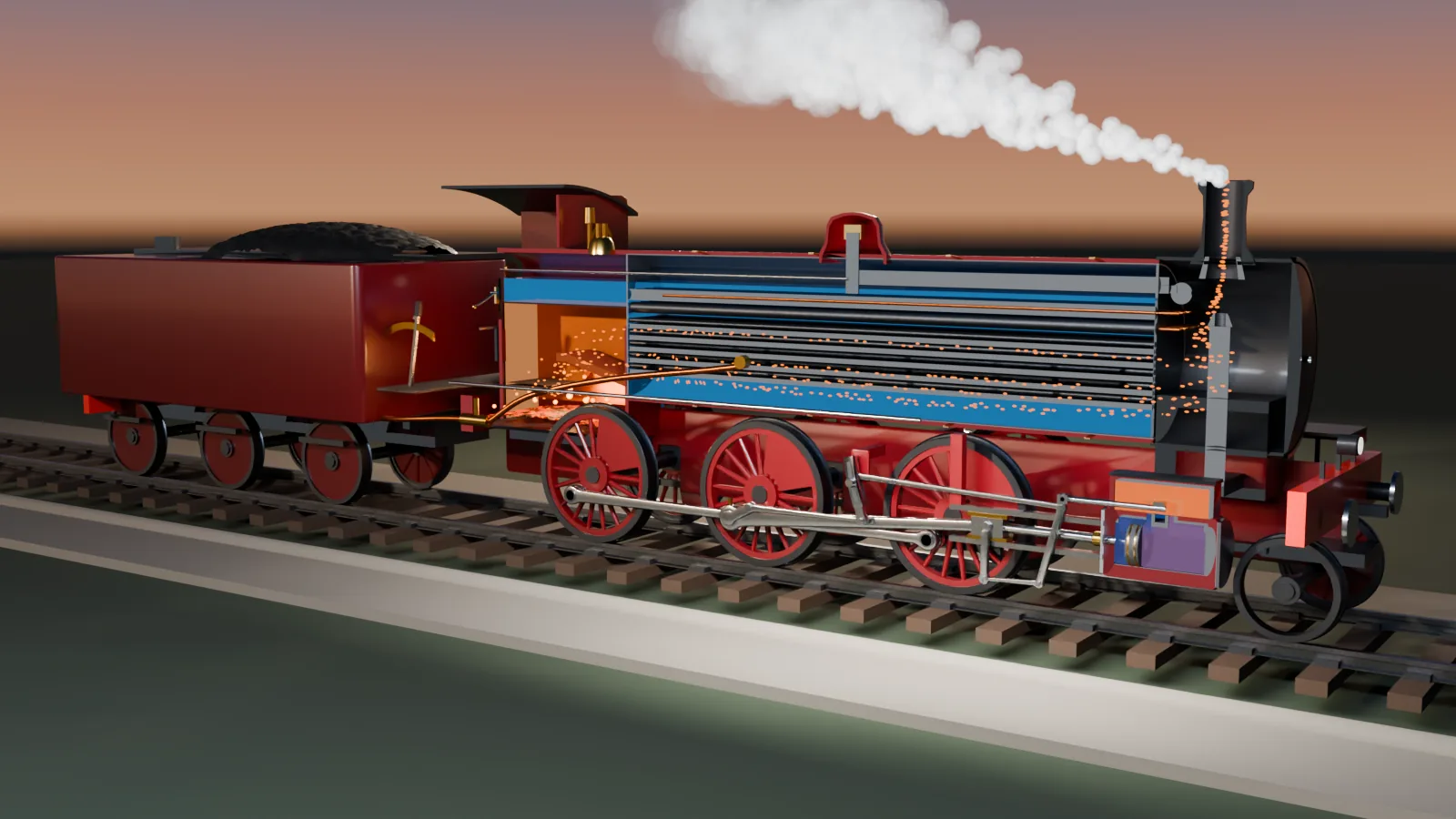
A coal fire boils water into high-pressure steam. The steam pushes two pistons back and forth, and strong rods turn that push into the turning of the wheels. Then the used steam blasts up the chimney and makes the fire burn hotter.
Video
The engine is already cut open along its middle. Open the regulator and the steam drives the pistons, the rods and the valve gear. Move the reverser to change the cut-off or to run backwards. Drag to turn the view, scroll or pinch to zoom, and click a part to use it.
The engine cut open along its middle, and its left cylinder cut through the steam chest. Tap any part of the picture or pick a name below. The fire and the boiler are on top, the cylinders at the front, and the rods and valve gear along the wheels.

Hover or tap the picture. Red rings mark every part.
The engine cut open, seen from its left side. The numbers follow the energy: 1 to 7 from the fire to the superheater, 8 to 16 where the steam does its work, 17 and 18 the exhaust, 19 to 22 the valve gear, and 23 to 26 the driver’s controls and the safety fittings.

The same steps as the video. Each picture is a moment from it; press Show me in 3D to set the model up for that step.

The left cylinder, cut open like the video’s drawing. Turn the wheel and watch the slide valve open one port to live steam and the other to the exhaust. Then take the valve yourself and try to keep the wheel turning.
The valve slides over three ports in the floor of the steam chest. Uncover a steam port and live steam from the boiler rushes into that end of the cylinder. Under the valve’s hollow, the other end is joined to the exhaust port, so its used steam can escape. Move the valve the wrong way, or at the wrong moment, and the steam pushes against the piston instead of with it.
The reverser sets how far through each stroke the valve lets steam in. To start a heavy train, the driver lets it in for most of the stroke. At speed, the driver cuts it off early and lets the steam already inside expand on its own, like a spring pushing out.
A piston at the very end of its stroke pushes straight through the axle, and the wheel cannot turn. So the engine has a cylinder on each side, with their cranks a quarter of a turn apart. Turn the wheel to any position and try to start.
The chart shows how hard each side can turn the wheel at every position, with full steam in the cylinder. One cylinder alone has two dead spots each turn. With the second side a quarter turn ahead, one of them is always pushing hard, so the engine can start wherever it stopped.
Every puff of used steam shoots up the chimney from the blast pipe and drags the smoke along with it. That sucks the hot gases through the tubes and draws fresh air up through the fire. Work the engine harder and it blasts harder, so the fire burns hotter and makes more steam.