
 Every Mechanism
Home How a Jet Engine Works
Every Mechanism
Home How a Jet Engine Works
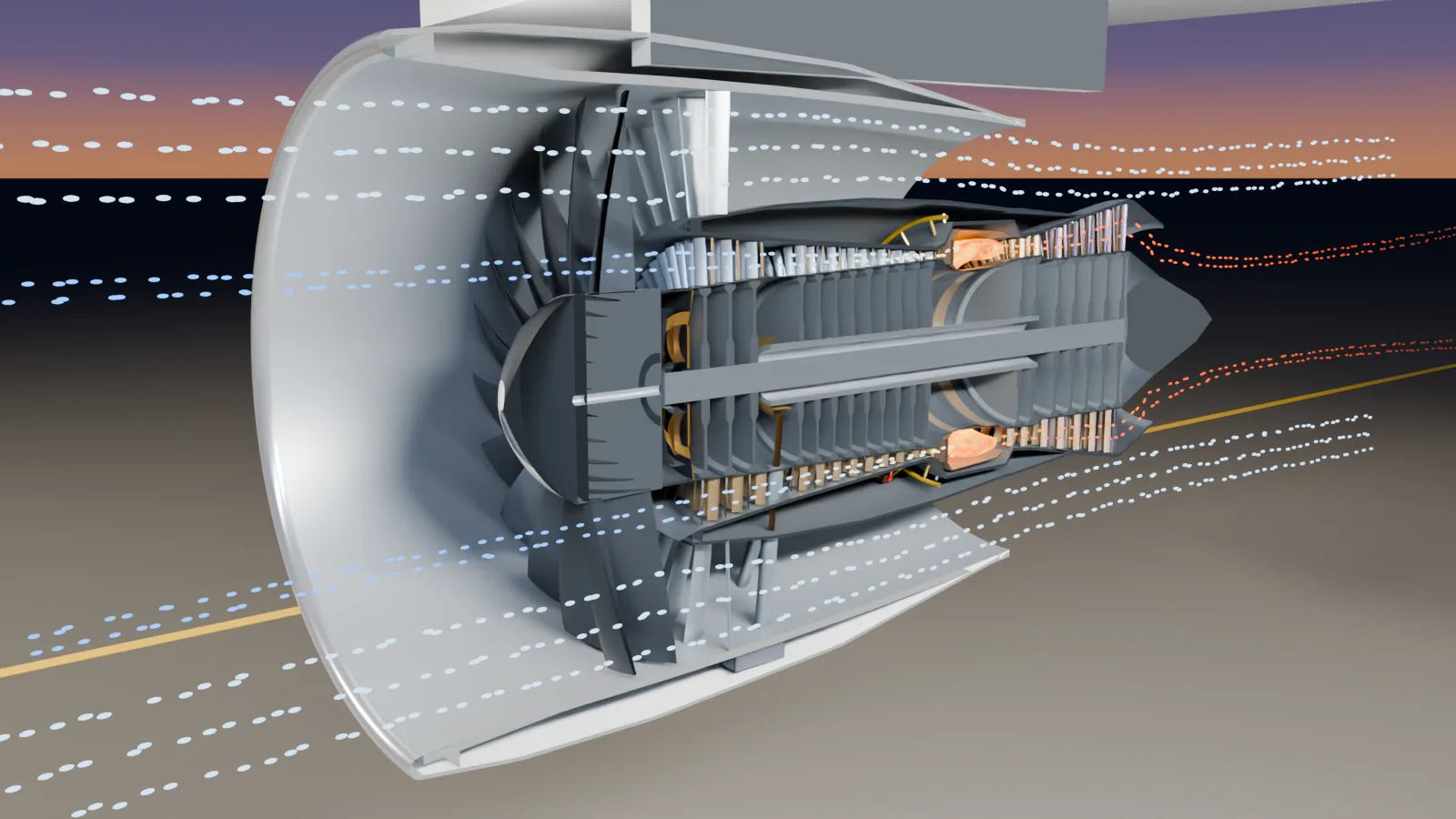
A giant fan pulls in the air. The core squeezes some of it forty times, burns fuel in it and lets it rush out through turbines that turn the fan and the compressor. Everything left over pushes the plane forward. This airliner engine even has a gearbox, so its huge fan can turn slowly while the turbine behind it spins fast.
Video
The engine is already cut in half along its axis. Press Start: air from the tail spins the core, the fuel lights, and the engine runs on its own. Then push the throttle to take-off. Drag to turn the view, scroll or pinch to zoom, and click a part to use it.
The engine cut in half along its axis, the air flowing from left to right. Tap any part of the picture or pick a name below. The fan and its gearbox are at the front, the core in the middle, and the gearbox that drives the engine’s helpers hangs underneath.

Hover or tap the picture. Teal rings mark every part.
The engine cut in half, seen from the side. The numbers follow the air: 1 to 14 along its path from the spinner to the exhaust, 15 to 22 the shafts and gears that carry the turbines’ power, and 23 to 26 the fuel and the starting system.

The same steps as the video. Each picture is a moment from it; press Show me in 3D to set the model up for that step.

Push the throttle and watch the three rotors speed up: the fan, the low pressure spool and the high pressure spool. Below them, follow the air through the engine and see its pressure and temperature climb, peak in the flame and fall again through the turbines.
The throttle sets how much fuel burns. More fuel makes the gas hotter, so the turbines push harder and both spools speed up, and the faster the compressor spins, the harder it squeezes. The core speeds up least: it is already turning fast at idle. The fan is geared to the low pressure spool, so it always turns at exactly a third of its speed.
Drag the sun gear in the middle (it is the turbine’s shaft) or press Run, and count: every three turns of the shaft, the ring gear and the fan go round once, the other way. Then see why the engine needs the gearbox at all: what the fan’s tips would do without it.
Give the same core a bigger and bigger fan. The core’s power then pushes a wider stream of air more gently, instead of a thin jet very hard. Watch the thrust, the jet’s speed, the noise and the fuel.
Thrust comes from throwing air backward: the mass of air each second times how much faster it leaves than it came. Doubling the speed of a jet takes four times the energy, but doubling the amount of air takes only twice as much. So moving a lot of air a little is the cheaper way to push, and a slower jet is far quieter too. Only the drag and weight of an ever bigger fan and nacelle set a limit.
Start the engine the way the engine’s computer does it, or do each step yourself: air from the APU, the starter, the igniters, the fuel. Then try what goes wrong if you do it in the wrong order.
The first turbine blades work in gas hotter than the melting point of the nickel alloy they are made of. Turn the cooling air and the ceramic coating off and on, and see what keeps them solid.
Each blade is hollow. Air taken from the end of the compressor, at about 600 °C, runs up passages inside it and out of rows of tiny holes, where it spreads over the skin as a thin cool film. A ceramic coating a few tenths of a millimetre thick adds another layer of insulation. Every bit of cooling air costs fuel, though: it took work to squeeze, but it skips the flame and gives little of that work back in the turbine.